
Yes, essential oils work great as perfume — but only when properly diluted in a carrier. You have two paths: buy a ready-made natural perfume, like an alcohol-free solid perfume, or blend your own perfume oil at home. INGRID's three scents Scandinavian Breeze, Whisper, and Velvet Vanilla cover the most common scent families if you'd rather skip the measuring and patch tests.
In short:
- Essential oils should be diluted in a carrier to be used as perfume, with jojoba oil a common choice for preserving the scent.
- Natural fragrance products can contain synthetic molecules and don't always consist purely of essential oils, which makes the ingredient list crucial.
- For home blending, test small batches, document your dosing, and let the mixture rest in the dark to ensure scent stability.
- Building a balanced perfume means understanding the split between top, heart, and base notes, and raising concentration for a stronger scent.
- Ready-made natural perfumes built on real fragrance oils and free of alcohol are a simple, reliable option for beginners.
Table of Contents
- The difference between essential oil, perfume oil, and fragrance oil
- Step by step: how to blend a perfume oil with essential oils
- Practical recipes and scent combinations to try
- How to choose a ready-made natural perfume or perfume oil
- Safety, allergens, and common misconceptions
- Our perspective: why we choose alcohol-free, wax-based perfumes
- How are essential oils extracted for perfume-making?
- How have essential oils been used in perfume historically?
- What I think you should prioritize first
- Try the scents before you decide
- Sources
The difference between essential oil, perfume oil, and fragrance oil
The three terms get mixed up constantly, and it costs you money when you buy the wrong product. Essential oils are extracted directly from plant material through steam distillation or cold pressing, while a so-called absolute is produced through a more specialized extraction method that captures fragrance compounds too delicate to survive the heat of distillation — jasmine and rose, for example. No batch is ever identical to the last, since harvest, soil, and weather all shape the scent profile.
Perfume oil and fragrance oil are broader terms. They can contain essential oils, but just as often contain nature-identical or fully synthetic molecules that mimic a plant scent without coming from the plant. Many natural fragrance oils actually combine essential oils with isolated natural molecules — citronellol or geraniol, for instance — to get a scent that stays stable over time instead of shifting from batch to batch.
The word “parfum” on an ingredient list reveals nothing about origin. It's a catch-all term the EU permits without specifying what the blend actually contains. Keep three things separate when reading a label:
- Essential oil: pure plant extraction, nothing added.
- Natural fragrance oil: essential oils plus natural isolates.
- Perfume oil/fragrance oil generally: can be entirely synthetic despite a natural-sounding name.
Step by step: how to blend a perfume oil with essential oils
You don't need lab equipment. A carrier oil, a few pipettes, and some patience get you most of the way.
Start by choosing your carrier. Jojoba oil is the go-to for most people since it barely oxidizes and is odorless, leaving your fragrance composition untouched. Almond oil works well for skin that can handle a bit more richness, while safflower oil is a cheaper option when you're mixing larger test batches.
Next, work out the concentration. A rule of thumb that works for home use: 1 milliliter of essential oil equals roughly 25 drops, and a typical perfume oil sits at 10–20% fragrance concentration in the carrier. If you want to blend 10ml of perfume oil at 10% concentration, you'll need about 25 drops of essential oil diluted in the rest carrier oil.
Then follow this order of operations:
- Mix a small test batch, 5–10ml, before committing to a bigger bottle.
- Write down the exact drop count per oil and total carrier volume, so you can recreate or adjust the recipe later.
- Shake the mixture and let it rest somewhere dark and cool.
- Test the scent on your skin only after the resting period, not right after blending.
- Transfer it to a dark glass bottle with a dropper insert for storage.
Pro tip: Log every test batch in a simple notes app with the date, oils, and drop counts. After five or six batches, you'll quickly see which combinations hold up and which break down too fast.
Practical recipes and scent combinations to try
A balanced perfume composition is built on three layers. A typical split in natural compositions runs around 5–20% top notes, 50–80% heart notes, and 20% base notes, calculated as a share of the total essential oil in the recipe — not the whole bottle's volume.
Four starter recipes for a 10ml bottle at 10% concentration (about 25 drops of essential oil total):
- Citrus: 8 drops bergamot, 12 drops geranium, 5 drops cedarwood.
- Floral: 6 drops ylang ylang, 14 drops lavender, 5 drops sandalwood.
- Gourmand: 5 drops orange, 10 drops cinnamon, 10 drops vanilla (or vanilla absolute).
- Woody/amber: 5 drops rosemary, 12 drops patchouli, 8 drops cedarwood.
Want a stronger, more perfume-like intensity? Raise the concentration to 15–20%, meaning 38–50 drops total per 10ml. Need the scent to last longer on skin? Increase the share of base notes, like cedarwood or patchouli. Want more “body” and a rounder character right from the start? Increase the heart notes, not the top notes, since those fade after an hour no matter how much you use.
How to choose a ready-made natural perfume or perfume oil
The fastest way to spot greenwashing is to read the ingredient list, not the marketing copy on the front. Look for botanical Latin names like Citrus bergamia or Lavandula angustifolia. If it just says “parfum” or “fragrance” with no further detail, you don't know what the bottle actually contains, no matter what the label claims up front.
Common warning signs to watch for:
- Phrases like “with natural fragrance” without any essential oil actually listed in the ingredients.
- Certifications with no verifiable issuing body, compared to established organic labels.
- Packaging that emphasizes a “natural feel” while listing synthetic musk or fixative compounds high up the ingredient list.
Format also affects how long a scent lasts and how much waste you create. A roll-on leaks less but needs alcohol or oil as a carrier; a dropper bottle gives you full control over quantity but is more prone to spills; and a wax-based solid perfume never leaks, contains no alcohol, and takes up little space in a bag.
Safety, allergens, and common misconceptions
The most common mistake is assuming “natural” automatically means “safe.” It doesn't. Natural fragrance compounds can contain more known allergens than some synthetic alternatives, and an oil-based perfume oil with a high concentration of, say, cinnamon or citrus can irritate sensitive skin just as much as a synthetic equivalent.
- Common allergens in essential oils: linalool, limonene, citral, and eugenol — all naturally present in citrus, cinnamon, and clove.
- Essential oils are highly concentrated and should never be used undiluted directly on skin.
- Always do a patch test on the inside of your elbow and wait 24 hours before applying a new blend more broadly.
- Pregnant or breastfeeding people, children, and anyone with skin conditions should consult a doctor or midwife before using potent essential oils like clove, cinnamon, or wintergreen.
Pro tip: Always keep a small, untouched sample of every test batch in the fridge. If you get a skin reaction weeks later, you can compare against the original mixture instead of guessing which ingredient was the culprit.
Our perspective: why we choose alcohol-free, wax-based perfumes
INGRID builds its perfumes on a wax base instead of alcohol and water. That gives longer shelf life in the bottle, no risk of spills, and a format that keeps the scent stable even after months in a bag.
- An alcohol-free, water-free formula that reduces packaging waste and lasts longer per purchase.
- Real botanical fragrance oils instead of purely synthetic isolates.
- A tree planted for every order, tying the purchase directly to a concrete environmental action.
- A sample kit lets you try every scent at home before deciding, with a discount on a follow-up purchase.
If DIY isn't for you, or you just want a reliable scent without measuring cups and pipettes, this is the simplest way in. Read more about INGRID and how the solid format differs from traditional liquid perfume.
How are essential oils extracted for perfume-making?
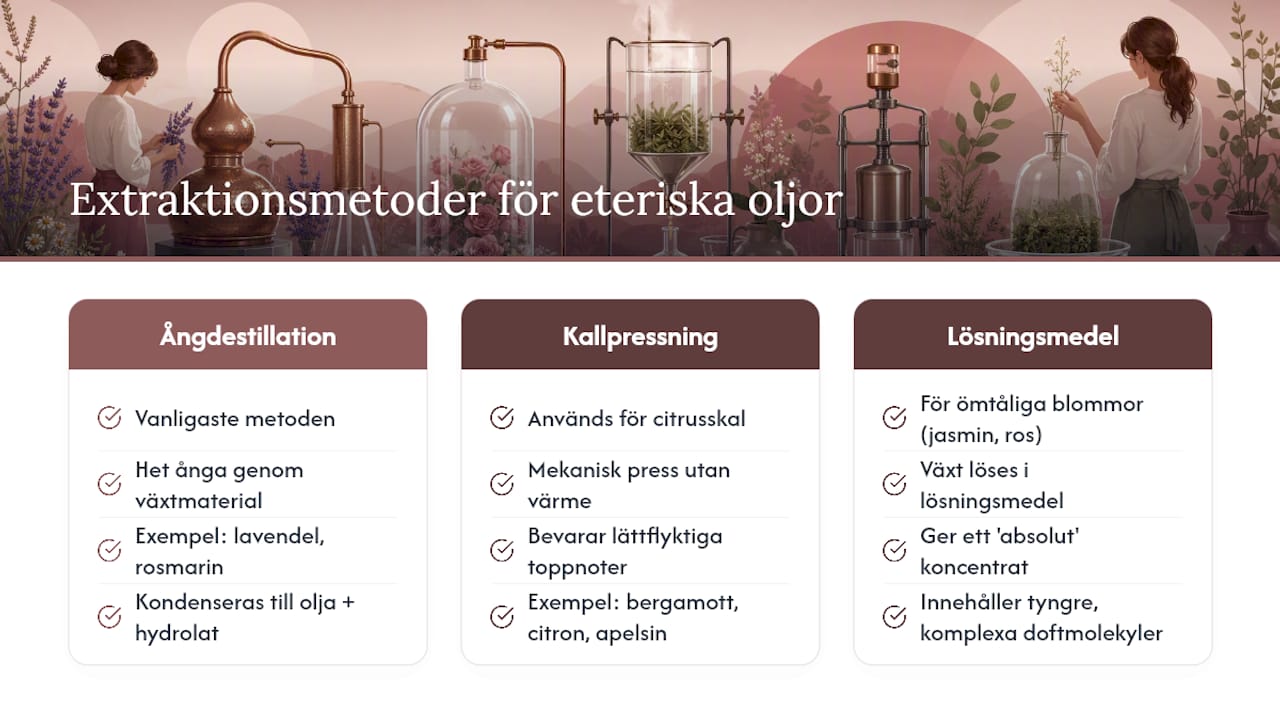
Steam distillation is the most common method, and the one behind most commercial essential oils. Plant material — lavender flowers or rosemary sprigs, say — is placed in a still where hot steam passes through it. The steam carries the fragrance molecules along, then condenses in a cooling system and separates into water (hydrosol) and oil (the essential oil, which floats on top).
Cold pressing is used mainly for citrus peels — bergamot, lemon, and orange. The peel is mechanically pressed with no heat, preserving the volatile top notes that heat would otherwise break down. That's why citrus oils often have such a vivid, sharp scent compared to distilled oils.
For flowers like jasmine and rose, where heat destroys the most delicate fragrance molecules, solvent extraction is used instead. The plant material is dissolved in a solvent that's later removed, and the result is an absolute — a highly concentrated extract that differs from a regular essential oil by containing more heavy, complex fragrance molecules.
Replicating these processes at home is, in practice, unrealistic. Steam distillation requires specialized equipment and large amounts of plant material — often several kilos of flowers to yield just a few milliliters of oil. As a DIY blender, you buy ready-made essential oils and focus your energy on mixing and composition instead, which is also where the actual craft of perfumery happens.
How have essential oils been used in perfume historically?
The craft of scent from plant extracts is far older than the bottle in your drawer. Egyptians used infused oils and resin in religious rituals and embalming thousands of years ago, and myrrh and frankincense were as much trade goods as fragrance materials.
The Persians developed early distillation techniques, and Arab influence during the medieval period carried the knowledge of extracting fragrance from roses and other flowers onward to Europe. Rosewater and rose oil became central to both medicine and perfumery in the Muslim world long before Europe followed suit.
In France, particularly around Grasse, an industry grew up around cultivating jasmine, rose, and lavender during the 1600s and 1700s. The town became synonymous with perfume craftsmanship, and many of the techniques developed there — like enfleurage, used to capture delicate floral scents in fat — are still referenced in perfumery schools today.
The modern breakthrough came when chemists learned to isolate, and later synthesize, individual fragrance molecules in the late 1800s. That made perfumes cheaper and more stable, but it's also the origin of today's distinction between a pure essential oil and a modern, synthetically enhanced perfume oil — the exact distinction you're navigating when you read an ingredient list today.
What I think you should prioritize first
The most common misconception in the fragrance world is that “natural” is automatically better or safer. It isn't, and I think many beginners hurt themselves by blending potent oils at too high a concentration simply because the bottle says “natural.” Prioritize dilution and patch testing over recipe creativity. A scent you love but can't wear on your skin is worthless.
Conventional buying guides focus too much on price and too little on the ingredient list. Learn to read Latin plant names before you worry about certification stamps, because stamps can be bought while an ingredient list can't lie in quite the same way.
If you're a beginner: start with a ready-made product to get familiar with scent families before investing in ten different essential oils that may never get used. DIY blending is rewarding, but it's a craft that takes time to learn, not a shortcut to a cheaper perfume.
— Axel
Try the scents before you decide
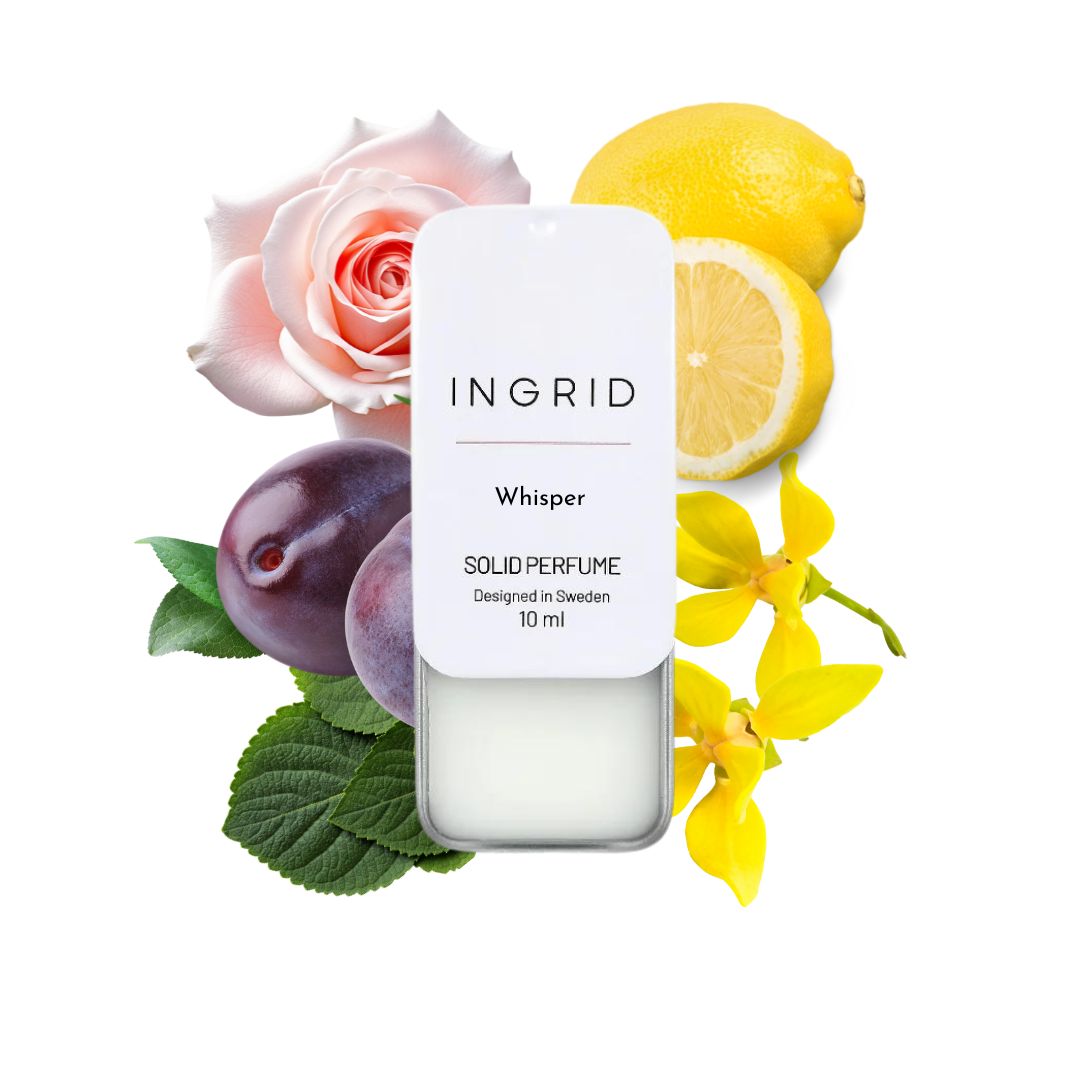
Want to skip the measuring cups, pipettes, and weeks of curing time? Three ready-made scents are already worth trying. Scandinavian Breeze delivers a fresh, Nordic feel with citrus and green notes that work all day. Whisper is the more discreet, heart-note-heavy scent for anyone who wants something subtle but distinctive. Velvet Vanilla covers the gourmand corner with a warm, round vanilla profile that lingers on skin thanks to the wax base.
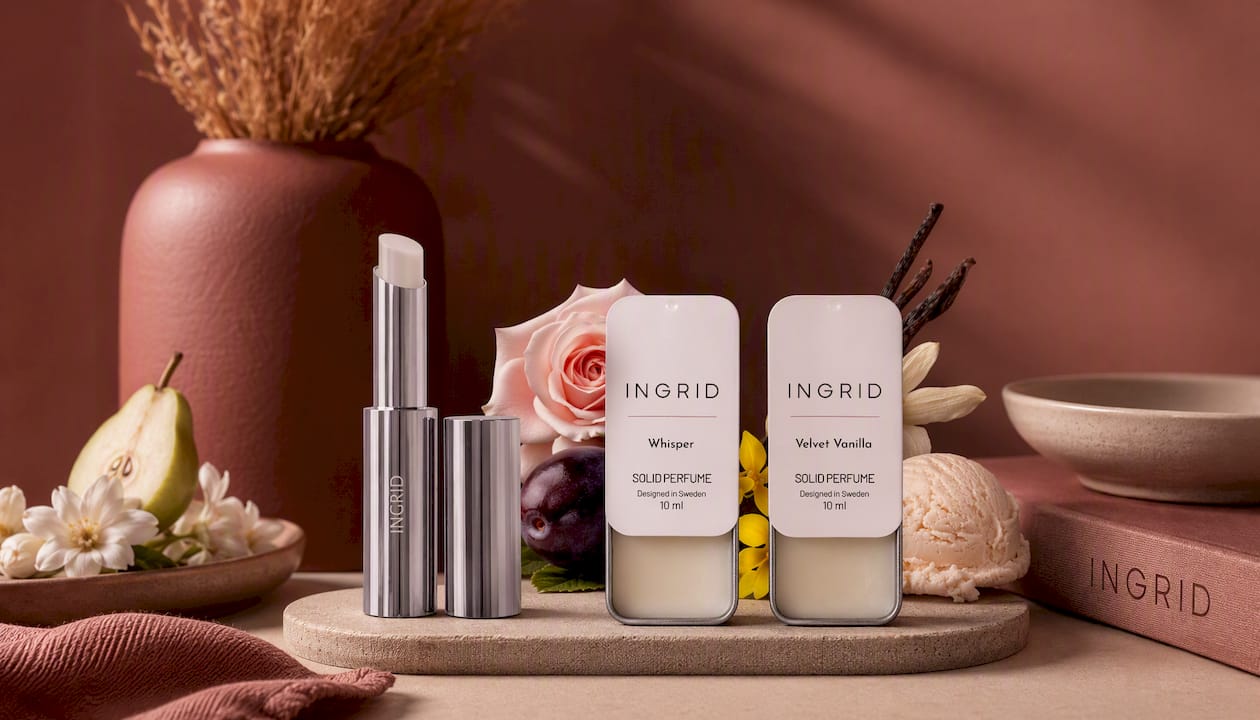
All three are built on real botanical fragrance oils, free of alcohol, water, and plastic packaging, and every order plants a tree. Before you settle on a favorite, order a sample kit and try the whole range at home, with a discount when you later buy a full-size bottle. Want to go straight for one scent? Visit the product pages for Scandinavian Breeze, Whisper, or Velvet Vanilla. Purchase terms and our return policy are clearly described if you want to check the details before you buy.
Sources
If you want to dig deeper into dosing, definitions, or safety, here are sources worth bookmarking:
- Natural and organic perfume – history, background, and tips (Swedish source)
- Scent school: essential oils & fragrance oils – Organic Makers (Swedish source)
- How to make your own perfume with essential oils (Swedish source)