
Yes, you can find perfume without phthalates. Choose certified natural perfumes, perfume oil, or solid perfume instead of alcohol-based sprays where the label just says “Parfum.” The EU bans the most hazardous phthalates, but diethyl phthalate (DEP) is still permitted as a solvent. That's why certification and ingredient transparency matter more than marketing terms like “phthalate-free.”
In short:
- Phthalates like diethyl phthalate (DEP) are still permitted in perfume as a solvent, which makes ingredient transparency more important than marketing claims of “phthalate-free.”
- Alcohol-based spray perfumes often contain synthetic fixatives that carry phthalate risk, while perfume oil and solid perfume reduce the need for such additives.
- A certification like COSMOS excludes phthalates, but it's still worth verifying content through full INCI lists and lab reports.
- Formats like perfume oil and solid perfume are often safer choices for sensitive skin since they contain no water, alcohol, or synthetic fixatives.
- Always check a product's ingredient list carefully and ask for documentation to avoid products hiding phthalates behind vague marketing.
Table of Contents
- Which fragrance formats reduce phthalate risk?
- What do EU rules say about phthalates in perfume?
- How to choose a perfume without phthalates, step by step
- Why solid perfume is often the safer choice
- Which certifications and labels can you trust?
- How to check product information before you buy
- What health risks are linked to phthalates in perfume?
- What replaces phthalates in modern perfumes?
- Advice for sensitive skin and allergies
- What we really think about the hunt for “phthalate-free”
- Discover INGRID's phthalate-free solid perfumes
- Sources
Which fragrance formats reduce phthalate risk?
Phthalates, especially DEP, are primarily used as solvents and fixatives in alcohol-based sprays. They keep the scent stable and sprayable over time. A water-free or alcohol-free format simply doesn't need the same chemistry to work, so the risk of phthalates drops significantly.
The three most common formats differ quite a bit:
- Alcohol-based spray (Eau de Parfum/Toilette): dissolves fragrance compounds in alcohol and water, often requiring synthetic fixatives like DEP to keep the scent consistent.
- Perfume oil: fragrance compounds are blended directly into a carrier oil, often jojoba or sweet almond oil, with no water or alcohol.
- Solid perfume: fragrance oil is bound in wax, typically beeswax or a vegan plant wax, and melts against the skin from body heat.
The difference shows up in use too. Spray disperses widely and evaporates faster, while oil and solid perfume sit closer to the skin and last longer since the wax or oil slows evaporation. Solid perfume is the most portable — it won't leak in your bag and doesn't need a plastic spray bottle.
Pro tip: Try solid perfume on pulse points like your wrists and the hollow of your collarbone. Body heat activates the wax and the scent builds gradually instead of hitting all at once — something many people with scent sensitivities appreciate.
What do EU rules say about phthalates in perfume?
The EU Cosmetics Regulation (1223/2009) bans phthalates classified as reprotoxic — substances suspected of harming reproductive health. The ban is listed in the regulation's Annex II, which forms the basis for what can and can't be included in cosmetics sold in the EU.
There's an important gap, though: diethyl phthalate (DEP) isn't covered by the ban and is still permitted as a solvent in perfume. DEP is usually exactly what's hiding behind the single ingredient “Parfum” or “Fragrance” on a bottle, since fragrance compositions in the EU can be protected as trade secrets and are therefore bundled into one word.
Want to verify a specific substance yourself? You can look it up in the EU's CosIng ingredient database or read the regulation directly on EUR-Lex. That's the only source that definitively states what's actually banned, unlike product copy that can freely use words like “non-toxic” without any legal meaning behind them.
How to choose a perfume without phthalates, step by step
Filtering out phthalates in practice is mostly about reading the right things in the right order, not trusting a single word on the bottle.
- Read the full INCI list, not just the front label. Phthalates almost always end in “-phthalate” on an ingredient list, e.g. Diethyl Phthalate. If it just says “Parfum” with no further breakdown, the manufacturer hasn't given you the information you need.
- Check the certification. A COSMOS label excludes phthalates entirely as part of the standard, making it one of the more reliable shortcuts on the market today.
- Ask customer service if you're unsure. Ask specifically for the full INCI or lab documentation for the fragrance composition, not just a generic “our products are clean.”
- Prefer perfume oil or solid perfume when you can. The format itself fundamentally reduces the need for synthetic fixatives, as covered above.
Pro tip: Never take the word “natural” alone at face value. It's not a protected term in the cosmetics industry, and a spray can be marketed as natural despite containing synthetic fixatives. Certification and a full ingredient list outweigh a loose adjective.
Vague marketing claims with no documentation behind them, an ingredient list missing entirely from the product page, or a “Parfum” with no explanation are all signs you should move on to the next option.
Why solid perfume is often the safer choice
Wax and oil solve the problem at the source. Without water and alcohol in the formula, there's simply no need for the synthetic solvents and fixatives that otherwise hold a liquid fragrance together. That's the same logic behind why perfume oil almost always has a shorter, more transparent ingredient list than a classic Eau de Parfum.
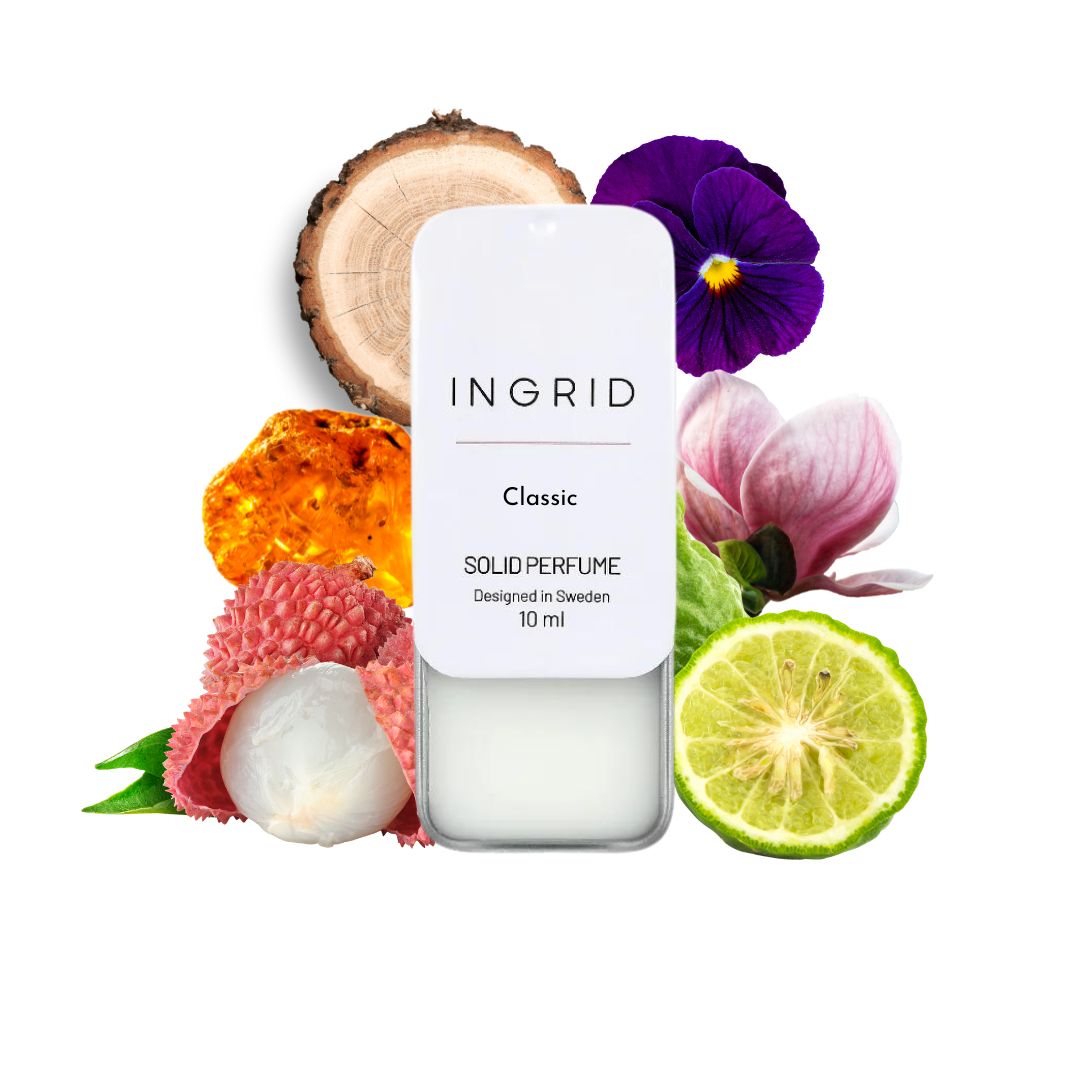
INGRID's solid perfumes are built on exactly this. The scents are vegan, wax-based, and completely free of alcohol and water, with fragrance oils sourced directly from plants instead of diluted synthetic blends. Every ingredient is listed openly, and a tree is planted with every order — a small but concrete environmental action beyond the formula itself. You can read more about the philosophy behind it on the brand page.
Three of the scents show the range of the collection:
- Scandinavian Breeze: a fresh, airy solid perfume scent, built for anyone who wants a clean, Nordic feel without a heavy synthetic base.
- Fleur Fantasy: a floral, more seductive scent profile, still in the same wax-and-oil-based, alcohol-free format.
- Velvet Vanilla: a warm, soft vanilla scent that sits closer to the skin longer thanks to the wax base — popular with people with sensitive skin who react to spray perfumes.
What all three have in common: the format itself reduces the need for the fixatives that might otherwise contain DEP.
Which certifications and labels can you trust?
COSMOS ORGANIC is the certification that gives the clearest answer. The standard excludes not just phthalates but also synthetic musks and a range of other synthetic additives, and requires documentation before the label can be used at all. Some COSMOS-certified perfumes reach up to 99.9% natural origin in their composition — a concrete figure to compare against, rather than a loose promise.
Beyond the label itself, there are three more things to check:
- A full INCI list, not just a catch-all word for fragrance compounds.
- Third-party testing or a lab report the manufacturer can produce on request.
- A product sheet specifying what “parfum” actually consists of, not just that it exists.
The word “phthalate-free” alone on packaging isn't enough. Without documentation behind the claim, it's just a marketing term — as Sweden's Giftkoll points out when it comes to interpreting INCI lists correctly.
How to check product information before you buy
Before adding a perfume to your cart, check the product page's full ingredient list, look for linked certificates, and take a look at photos of the actual label — not just the marketing copy above it.
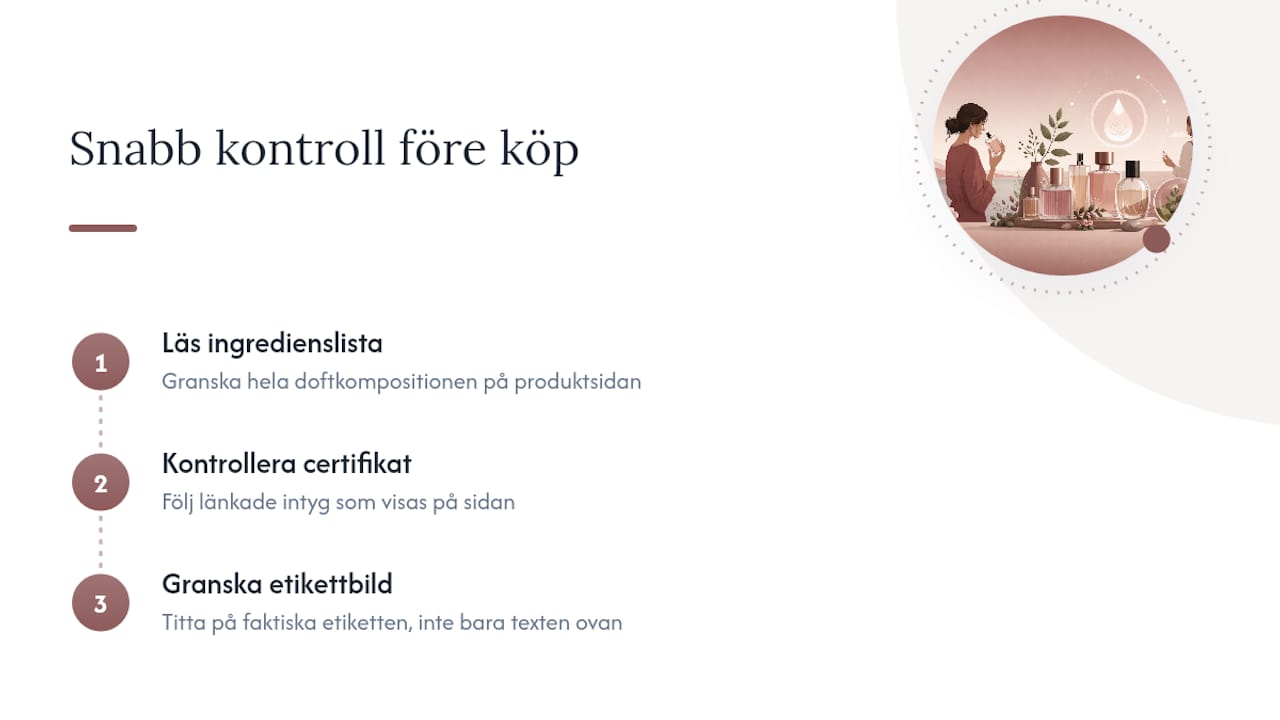
If the information is missing, use a simple template when emailing customer service: ask for the full ingredient list for the fragrance composition, ask whether a certificate is available, and request a lab analysis if the product claims to be phthalate-free without showing it.
INGRID lists its ingredients openly on every product page, and you can browse the full range in the collection before deciding. Not sure if a scent is right for you? There's also clear information on returns if the purchase doesn't feel right.
What health risks are linked to phthalates in perfume?
Concerns about phthalates in cosmetics have existed for a long time. As early as the mid-2000s, analyses found phthalates present in a large number of perfumes on the market, which contributed to today's stricter EU requirements for disclosure and limit values.
The phthalates fully banned in the EU today are those classified as reprotoxic — substances suspected of negatively affecting fertility at sufficient exposure. DEP, still permitted, is generally considered less problematic, but that doesn't mean it's free of all debate. Since the scientific understanding keeps evolving, it's wise not to rely solely on the fact that a substance happens to be legal today.
Pregnant or breastfeeding people, or those with known fertility concerns, shouldn't base their choices purely on product marketing. Consult a healthcare provider if you have specific questions about exposure, rather than trusting a word like “natural” on the bottle. For most consumers, it's more about reducing unnecessary exposure over time than an acute danger from occasional use — but the principle of choosing transparent, certified alternatives still holds.
What replaces phthalates in modern perfumes?
When manufacturers deliberately avoid DEP and other phthalates, they still need to solve the same technical problem: how to keep the scent together and lasting on skin. The solution varies by format.
In alcohol-based sprays, other synthetic fixatives not classified as phthalates are often used instead — certain cyclic compounds, for example — or nature-based fixatives like benzoin resin and labdanum, sourced from plant resins. In perfume oils and solid perfumes, the problem more or less resolves itself through the base itself: wax or carrier oil binds fragrance molecules physically rather than chemically, making separate fixatives largely unnecessary in the first place.
Natural essential oils — from citrus, clove, or various woods, for example — are used both for scent and to give the composition some stability. The difference from synthetic fixatives is that these compounds are more often listed under their own name in the INCI list instead of being hidden behind the word “parfum,” which in itself gives you, as a buyer, a better ability to judge what you're actually putting on your skin.
Advice for sensitive skin and allergies
If you have sensitive skin or known fragrance allergies, somewhat different priorities apply than simply hunting down phthalates. A short ingredient list almost always beats a long one, regardless of whether the product is certified phthalate-free, since every additional compound is a potential trigger.
Alcohol itself can dry out and irritate sensitive skin, which makes alcohol-free formats like perfume oil and solid perfume a doubly good choice: you avoid both dryness and the most common carrier for synthetic fixatives. Always test a new scent on a small patch of skin, like the inside of your elbow, and wait 24 hours before applying it more broadly.
Also watch for known allergens like limonene, linalool, and eugenol in the INCI list — EU rules require these to be declared separately above a certain concentration, precisely because they're common causes of contact allergy. A certification like COSMOS doesn't just restrict phthalates; it also tends to keep the total number of synthetic additives down, which indirectly benefits sensitive skin even though that's not the certification's main purpose.
What we really think about the hunt for “phthalate-free”
The most common misconception is that the word “natural” or “phthalate-free” on a label is enough proof on its own. It isn't, and it never has been. The real dividing line is between products that show their full ingredient list and those that hide behind a single catch-all word.
I think many consumers spend too much energy hunting for the perfect single word on the bottle and too little asking for the documentation behind it. A certification like COSMOS isn't magic, but it forces a transparency that marketing copy never provides on its own.
If I had to point to one single priority: choose the format before you choose the brand. A water-free, alcohol-free alternative like solid perfume or perfume oil solves a large part of the phthalate problem at the root, before you even need to read a single ingredient list in detail. It's not the whole solution, but it's the most reliable shortcut actually available right now.
— Axel
Discover INGRID's phthalate-free solid perfumes
INGRID is the option for anyone who's already decided to move away from alcohol-based sprays with hidden fixatives. Here, you get wax-based solid perfumes completely free of alcohol and water, with fragrance oils sourced directly from plants and an ingredient list you can actually read and understand.
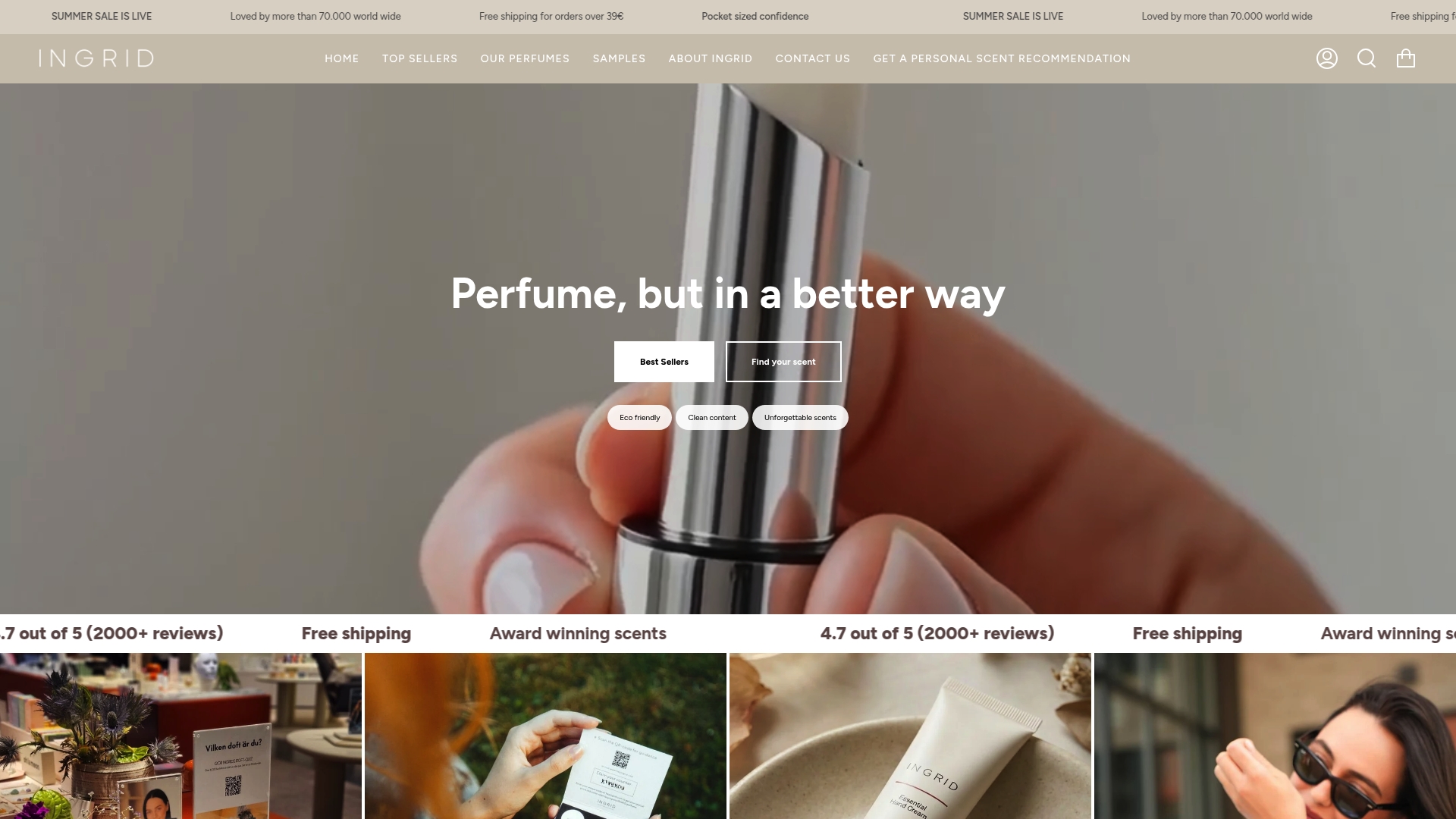
Every solid perfume is formulated without the solvents that otherwise often carry phthalates, and every order helps plant a tree. Not sure which scent is right for you? Try Scandinavian Breeze for a fresh profile or Velvet Vanilla for something warmer and softer. Want to try the whole range before deciding? Order a sample kit through the collection page, and the cost is deducted from a later full-size purchase. Add your first solid perfume to your cart today and feel the difference from a regular spray after just one application.