
An unopened bottle of perfume often lasts several years, sometimes decades, if stored cool and dark. An opened bottle is generally expected to last several years too, with variation depending on concentration and scent family. Light, heat, and oxygen are the biggest factors, and the PAO symbol on the bottle gives you a solid reference for how long the scent holds its quality once opened.
In short:
- An unopened bottle can last for decades if stored cool and dark, while an opened bottle is usually best within 3–5 years depending on storage conditions.
- UV light, temperature swings, and oxygen all shorten a fragrance's lifespan, especially in clear glass bottles or with poor storage.
- Concentration and scent notes determine how quickly a perfume loses quality — citrus is the most fragile, while woody scents are more stable.
- To extend shelf life, store perfume somewhere dark, cool, and dry, with the bottle upright and the cap tightly closed.
- Solid perfumes without alcohol or water can be a more durable alternative, since they're exposed to less air and are less prone to degrading over time.
Table of Contents
- How long does an unopened perfume last?
- How long does an opened perfume last?
- What affects how long perfume stays fresh?
- How to store perfume for maximum shelf life
- How to tell if your perfume has gone bad
- Solid perfume as a more durable alternative
- Checklist: 8 steps for longer shelf life
- What a perfume maker thinks about the shelf-life question
- Try a wax-based alternative from INGRID
- Sources
How long does an unopened perfume last?
A sealed bottle holds up considerably better than an opened one, for a simple reason: the cap or spray head keeps oxygen out. Oxidation is the process that gradually breaks down fragrance molecules, and without air contact that process moves very slowly. The alcohol in perfume also acts as a preservative, which means a sealed bottle rarely spoils the way a water-based cream would — though the scent can still shift slightly over time through oxidation.
As a rule of thumb, an unopened bottle lasts several years up to decades, though it varies depending on how the bottle was handled before you bought it. A perfume that sat in a sunlit shop window ages faster than one kept in dark, cool storage.
Want to know exactly how old a bottle is, opened or not? Check the batch code:
- Look for a short code, often printed on the bottom of the bottle or underside of the box.
- Enter the code into a tool like CheckFresh to get the manufacturing date.
- Compare that date with how long the bottle has been with you or on a shelf, for a realistic picture of remaining shelf life.
- Be extra careful checking this when buying secondhand perfume, since you don't know how the bottle was stored before.
How long does an opened perfume last?
The moment you break the seal, oxygen starts contacting the liquid and degradation speeds up. That's why manufacturers often mark a PAO symbol — a small open-jar icon with a number like "12M" or "36M" — indicating how many months the product is recommended for use after opening. It's a guideline rather than a hard limit, but it gives you a concrete benchmark.
Rule of thumb: most beauty guides land on 3–5 years as a practical benchmark for opened perfume, though exact figures vary by source depending on concentration, scent notes, and storage.
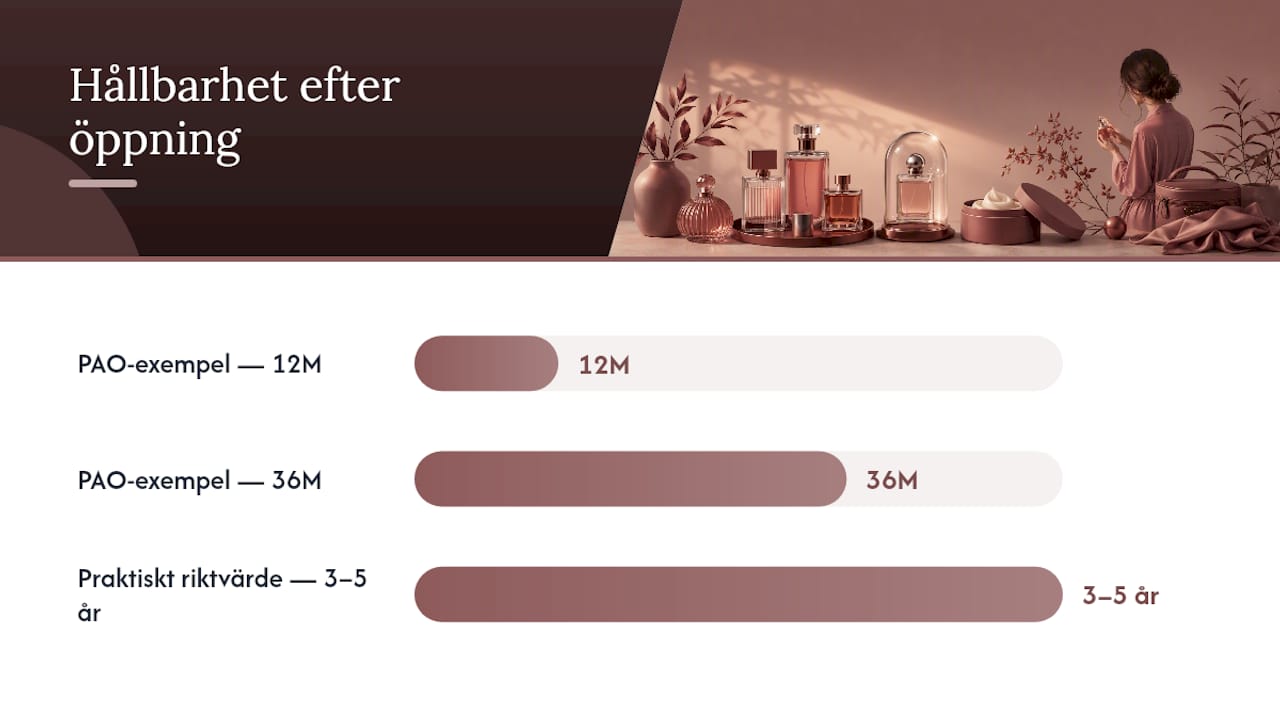
Under EU cosmetics regulation, manufacturers only need to print a best-before date if a product's expected shelf life is under 30 months. That's why many alcohol-based perfumes have no printed expiry date at all: their expected lifespan normally exceeds that threshold, according to Sweden's Medical Products Agency (Läkemedelsverket).
Two factors drive how quickly an opened bottle changes:
- Concentration: Eau de Parfum contains more fragrance oil relative to alcohol and is generally more stable than Eau de Toilette or Eau de Cologne, according to Metro Mode.
- Scent notes: citrus notes like bergamot and lemon break down fastest, while heavier base and woody notes stay stable much longer.
What affects how long perfume stays fresh?
In practice, four factors determine your perfume's entire shelf life, and they often interact with each other.
- Oxidation. Oxygen reacts first with the lightest molecules — the top notes — which is why an old perfume often smells "flatter" or sourer than when it was new.
- Light and UV exposure. Sunlight breaks down fragrance molecules and can even discolor the liquid over time, especially in clear bottles without tinted glass.
- Temperature swings and humidity. Fluctuating temperature makes the liquid and air inside the bottle expand and contract, effectively "breathing" air in through seals and speeding up degradation, according to Parfymhemmet. Stable temperature matters more than extreme cold.
- Scent family and concentration. Citrus fragrances age fastest, while woody and amber scents last longest. Higher concentration means more preservative alcohol relative to water-soluble compounds.
Pro tip: Never store perfume on a bathroom shelf. The humidity and temperature swings from showering and bathing are exactly the combination that speeds up oxidation the most.
How to store perfume for maximum shelf life
Proper storage is the single biggest factor you control yourself. The goal is simple: dark, cool, dry, and stable.
- Choose a closet, drawer, or cabinet away from direct sunlight and away from radiators or windows.
- Keep the original box as long as you can — it blocks light and adds a layer of insulation.
- Store the bottle upright to minimize the contact area between liquid and cap.
- Always screw the cap or spray head fully closed after use to minimize air exchange.
- Avoid storing a collection in a regular fridge — the humidity does more harm than the cool temperature does good. A dedicated wine fridge works better for chilling a larger collection, according to Parfymhemmet.
Different rules apply while traveling. A car parked in the sun can reach temperatures that damage perfume within an hour, so never leave a bottle in the glovebox or luggage in the heat.
| Situation | Recommended action |
|---|---|
| At home, daily storage | Dark cabinet, upright, original box kept |
| Bathroom | Avoid — move to bedroom or closet instead |
| Travel | Travel atomizer, wrapped in soft clothing in your bag |
| Car | Never leave perfume in the car — heat damages it fast |
| Larger collection | Wine fridge rather than a regular refrigerator |
If you're using a small travel atomizer, simply wrap it in a pair of socks or a sweater in your bag. That protects it from both impact and temperature swings during transport.
How to tell if your perfume has gone bad
Your nose is the best tool you have. Spray a small amount on a test strip or your wrist and wait a few minutes before judging the result.
- The scent has changed: if the top notes are completely gone and what's left smells sour, vinegary, or "muted," oxidation has progressed significantly.
- Discoloration: a perfume that's turned darker or yellowed compared to how it originally looked suggests light or heat damage.
- Cloudiness or separation: if the liquid looks cloudy or separates into layers, that's a clear sign the formula has broken down, according to Parfymhemmet.
- Skin reaction: if you get redness, itching, or irritation you haven't had before with the same perfume, stop using it immediately — ingredients may have broken down into new compounds your skin reacts to.
Solid perfume as a more durable alternative
Traditional spray perfume relies on alcohol as a carrier, which gives quick evaporation but also a fresh contact surface with air every time you spray. Solid perfume, built on a wax-based, alcohol-free formula, works differently: the fragrance oils sit embedded in the wax, which means less air exposure with every use.
The practical result shows up in everyday use in a few ways:
- Less air space in the packaging means less oxygen contact over time compared to a half-empty spray bottle.
- A solid stick sits stable in a bag or on a shelf without the risk of leaking or shattering the way glass can.
- The formula contains no water, removing one of the factors that can otherwise speed up degradation in some cosmetic products.
Scandinavian Breeze from INGRID is an example of a vegan, wax-based stick built on that principle, using real botanical fragrance oils instead of synthetic fillers.
Checklist: 8 steps for longer shelf life
- Always store somewhere dark, cool, and dry — never in the bathroom.
- Keep the bottle upright and screw the cap on tightly after every use.
- Keep the original box as extra light protection.
- Avoid rubbing perfume into your skin — it breaks down fragrance molecules faster.
- Buy smaller bottles if you rarely use the same scent, so you don't end up storing it too long.
- Check the batch code if you're unsure of a bottle's age, especially with secondhand purchases.
- Don't hang on to small leftover amounts "just in case" for years — it's better to let them go.
- Always do a skin test before using a perfume that's been sitting unopened or opened for a long time.
What a perfume maker thinks about the shelf-life question
Working with natural fragrance oils and wax-based formats gives you a different relationship with durability than the classic spray bottle does. The climate and consumption question isn't just about ingredients — it's about how long a product actually stays good to use before it gets thrown away unnecessarily.
My honest recommendation: trust your nose over the date. If the scent feels flat, sour, or just different from what you remember, it's time to move on, regardless of what a symbol on the bottle says.
— Axel
Try a wax-based alternative from INGRID
Spray bottles require alcohol as a carrier, which always means a trade-off between quick evaporation and air contact every time you use them. There are alternatives: vegan, wax-based solid perfumes with no alcohol and no water, packaged without plastic.
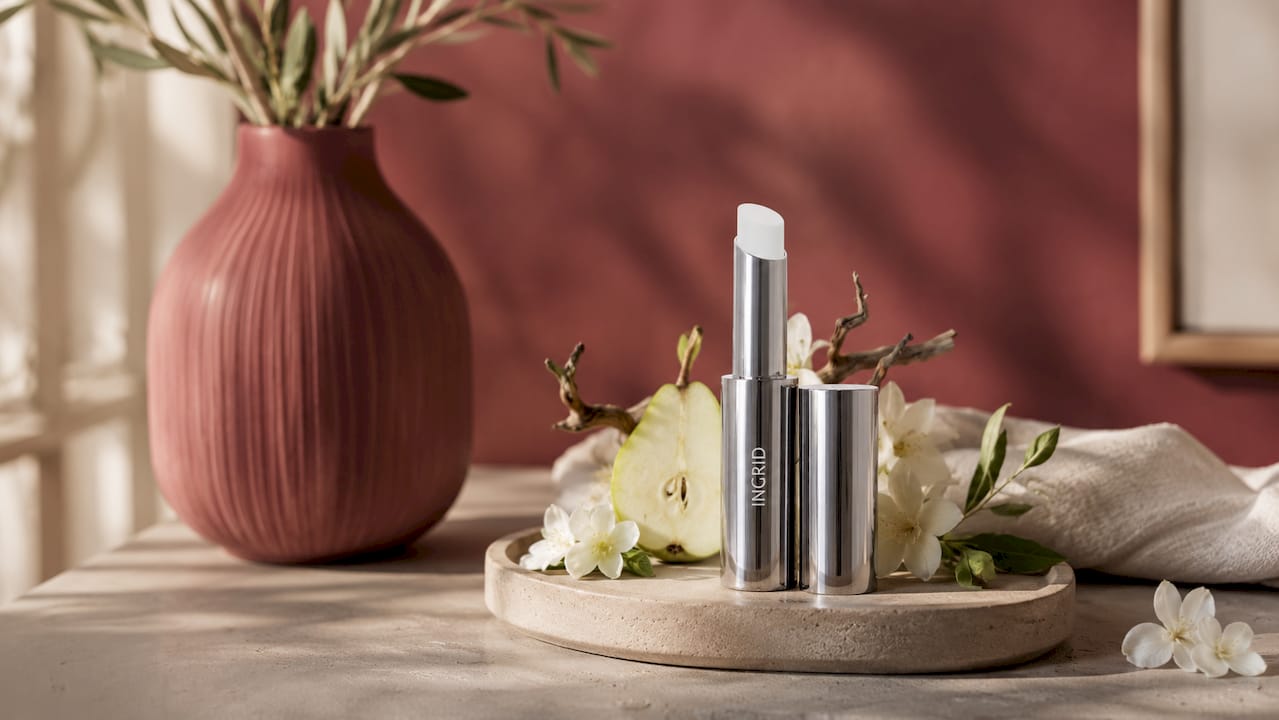
Scandinavian Breeze is a stick built on real botanical fragrance oils, designed to sit stable in a bag or on a shelf without leaking. Not sure which scent suits you? Try a sample kit at home and get a discount on a future purchase. Every order also means a tree gets planted, connecting your everyday scent to a greener choice. Visit INGRID to read more about the formulation, or go straight to the Scandinavian Breeze product page to order your sample kit.