
Cruelty-free means the perfume wasn't tested on animals at any stage of production. Vegan means the formula contains no animal-derived ingredients. The two terms often overlap, but they aren't the same thing, and EU regulation makes certain marketing claims less trustworthy than they sound. Before you buy: check certifications like Leaping Bunny or Vegan Society, read the INCI list, and test the scent with a sample kit at home.
In short:
- Cruelty-free means no part of the perfume — neither the ingredients nor the production — was tested on animals, while vegan means the formula contains no animal-derived materials.
- A brand can be cruelty-free without being vegan, and vice versa, since animal testing can still occur in certain countries even without certification.
- Check certifications like Leaping Bunny or Vegan Society through their own databases, and review the INCI list carefully to confirm both ethics and content.
- Common animal-derived ingredients to watch for include beeswax, honey, lanolin, ambergris, castoreum, and carmine — and substitutes are widely available today.
- Testing a scent on your skin at home before buying, and choosing wax-based solid perfumes, can reduce climate impact and lead to more ethical choices.
Table of Contents
- Cruelty-free vs. vegan in the perfume world
- How to verify cruelty-free and vegan status
- Common animal-derived ingredients to avoid in INCI
- How to test and buy cruelty-free perfume without regretting it
- Why INGRID's wax-based solid perfumes suit the ethical buyer
- Ethics and transparency should guide your choice, not just the label
- Try INGRID's vegan solid perfumes risk-free
- Sources
Cruelty-free vs. vegan in the perfume world
The two words describe completely different things, even though they often end up on the same bottle. Cruelty-free refers to the process: no part of the product — not the ingredients, not the finished blend — was tested on animals. Vegan refers to the content: the formula contains no substances derived from animals, regardless of whether testing occurred.
The distinction isn't academic — a vegan perfume doesn't automatically qualify as cruelty-free, and vice versa. A brand might use exclusively synthetic or plant-based raw materials, but if the company sells in countries that require animal testing for import, the product can still count as animal-tested somewhere in the supply chain.
Conversely, a perfume can be entirely free of animal testing but still contain animal-derived ingredients collected without harming the animal — beeswax, for instance. That makes it cruelty-free but not vegan.
A few concrete examples make the distinction clearer:
- A scent can be cruelty-free because the brand never tests on animals, yet still contain honey or lanolin, which makes it non-vegan.
- Another scent can be 100% vegan in its formula but sold through retailers in markets where third-party testing is still required, complicating its cruelty-free status.
- A third scenario: a brand markets itself as “natural” without mentioning animal testing or ingredient origin at all — which really says nothing about either.
If you shop with ethics in mind, both dimensions matter. If you're allergic to animal-derived substances or follow a fully vegan lifestyle, checking for a bunny logo on the bottle isn't enough. You need both checks: the process and the content.
How to verify cruelty-free and vegan status
A sticker on the packaging tells you nothing if you don't know what it actually guarantees. Four certifications dominate the international market, and they each check different things.
Leaping Bunny is the most rigorous cruelty-free standard. Certification requires the brand, along with all its suppliers, to certify in writing that no animal testing has occurred, and it's audited on an ongoing basis. PETA Beauty Without Bunnies functions as a self-declaration where brands register and pledge not to test on animals, making it easier to obtain but somewhat less rigorously checked than Leaping Bunny. The Vegan Society, known for its flower logo, certifies that a product is free of animal-derived ingredients and that the manufacturing process doesn't unnecessarily involve animal testing. Choose Cruelty Free, more common in Australia, sets requirements similar to Leaping Bunny but with local auditing.
None of these certifications is a universal solution, though. A brand can meet the EU's legal requirement to never test cosmetics on animals, yet still choose not to certify at all, making it harder for you as a consumer to verify the claim without digging deeper. And a brand selling in China may be forced to accept animal testing as a condition of market access, even if the rest of the world gets a cruelty-free version of the same product.
Here's a practical approach before you add a perfume to your cart:
- Look up the certification logo on the bottle or packaging and verify it directly in the certifying body's own database, not just on the brand's own site.
- Visit the brand's website and look for a clear policy on animal testing and the supply chain. Transparency about raw materials and suppliers is a better sign of credibility than a vague marketing phrase.
- Compare the INCI list against a list of common animal-derived ingredients (see the next section) to check whether the formula is truly vegan, not just cruelty-free.
- Check whether the brand sells in markets with legal animal-testing requirements, for example by searching the brand's name plus “China” or “animal testing policy.”
- If you're unsure, email the brand directly and ask for written confirmation of their supply chain status. A company with nothing to hide will respond quickly and specifically.
Databases like PETA's list of cruelty-free fragrance brands are a good first stop when you want to quickly check a brand before buying.
Pro tip: Never treat the word “natural” as an indicator of vegan status. Natural ingredients like beeswax, honey, and musk all come from animals, so “natural” and “vegan” aren't interchangeable terms.
Common animal-derived ingredients to avoid in INCI
The ingredient list, INCI, is the only reliable source when you want to know exactly what a perfume contains. The marketing copy on the front almost never tells the whole story.
Six ingredients show up again and again in perfumes marketed as “natural” without being vegan:
- Cera Alba (beeswax): often used as a base in solid perfumes and balms to provide structure and melting temperature.
- Ambra (ambergris): a rare substance from sperm whales, historically used as a fixative to extend scent longevity.
- Castoreum: a secretion from beavers' scent glands, formerly common in leathery, powdery scents.
- Myroxylon (Peru or Tolu balsam): plant-derived on its own, but often blended with animal-derived fixatives in older formulas, which is why it needs extra scrutiny.
- Lanolin: a fat from sheep's wool, common in creamy formulations and balms.
- Carmine / CI 75470: a red pigment extracted from cochineal insects, rarely used in perfume but present in some tinted solid formats.
These substances still appear in perfumes on the market today, especially in solid perfumes and so-called “natural” blends where beeswax is used as a structuring agent rather than a fragrance component. The problem is that many of these substances have multiple chemical or trade names, so you need to recognize them in different forms to spot them automatically in an ingredient list.
Fortunately, solid substitutes exist for nearly every animal-derived raw material today. Candelilla wax and soy wax replace beeswax as a structuring agent in solid formats. Synthetic ambroxide, made from clary sage oil rather than whales, delivers the same deep, warm base note as natural ambergris without any animal cost. Plant-based fixatives like benzoin or labdanum can replace both castoreum and animal-derived fixatives in classic formulations.

Pro tip: If a perfume calls itself “natural” but lists no certifications at all, treat that as a warning sign rather than a quality promise. Natural and ethical aren't the same claim.
How to test and buy cruelty-free perfume without regretting it
Buying perfume online without being able to smell it first is a guessing game, and it often leads to returns. Returns, in turn, mean extra shipping, extra packaging material, and in the worst case a bottle thrown away simply because it was opened.
Testing scent samples before a full-size purchase reduces both impulse buying and the number of returns, which in turn lowers the climate footprint of the whole purchase. The logic is simple: the more confident you are in a scent before paying for a full-size product, the lower the risk that the bottle ends up in a return shipment or, worse, the trash after a single try.
Here's how to test a scent properly:
- Apply the sample to your skin, not just paper or fabric. Your skin chemistry, pH, and body temperature all affect how a scent develops, and a fragrance that smells amazing on a fabric strip can come across completely differently on your arm.
- Wait at least 30 minutes before judging the overall impression. The first few minutes are dominated by the top notes, usually the most volatile. The heart and base notes — the ones you actually wear all day — emerge later.
- Test the scent over several days and in different settings, ideally a day at work and an evening out, before committing to a full-size purchase.
- Compare several scents at once by testing one per wrist instead of reviewing them one at a time, which makes it easier to tell which one actually appeals to you most.
Once you've settled on a scent, the format itself affects how sustainable the purchase is. Wax-based solid perfume needs no alcohol or water-based filler, which often means less packaging material and a longer shelf life in your bag compared to a traditional spray bottle. Look for refillable containers or formats that minimize plastic use, and factor in how many applications a package actually delivers before comparing price per milliliter.
Pro tip: Never test more than three scents at once if you want to actually tell them apart. Your nose gets “tired” after that, and every new impression starts to blur together.
Why INGRID's wax-based solid perfumes suit the ethical buyer
INGRID builds its perfumes on wax instead of alcohol and water — a technical difference with practical consequences. A wax-based solid perfume releases scent more slowly because the wax holds the fragrance oils closer to the skin, which often means a longer perceived lifespan compared to a liquid spray of the same concentration.
The format also reduces waste in several ways at once:
- No alcohol or water filler means less volume to transport and less packaging material per scent.
- Wax-based formats generally need less packaging overall and can be formulated completely water-free, which matters if you factor climate impact into your buying decision.
- Every order at INGRID results in a tree being planted — a concrete environmental commitment tied directly to the purchase, rather than a vague sustainability slogan.
- The scents are built on real botanical essential oils rather than purely synthetic molecules, giving a more nuanced scent development.
The sample kit is the practical solution to the testing problem from the previous section: you can try every scent at home before committing to a full-size product, and the cost of the sample kit is deducted from a later full-size purchase.
| Feature | What it means for you |
|---|---|
| Wax base, no alcohol/water | Longer shelf life in your bag, less volume to transport |
| A tree planted per order | A concrete environmental commitment tied to every purchase, not a vague pledge |
| Real essential oils | More complex, natural scent development over the day |
| Sample kit with purchase credit | Lower risk of regretting a full-size purchase, fewer returns |
Free of plastic packaging is another detail that makes a difference in the overall environmental calculation, especially compared to spray bottles that often combine glass, plastic caps, and plastic seals in a single product.
Ethics and transparency should guide your choice, not just the label
What strikes me after digging through certifications, INCI lists, and EU regulation is how often consumers trust a logo instead of asking what that logo actually guarantees. A bunny symbol on the bottle feels reassuring, but PETA's own certification is based on self-declaration, while Leaping Bunny requires ongoing audits. That's not the same level of assurance, even though both look roughly the same in an online shop.
The nuance I think more people should take seriously is the double-edged nature of EU law. The EU bans animal testing on cosmetics, but that ban doesn't automatically protect you if the brand also sells in markets that require testing as a condition of import. A brand can be legally compliant in Sweden and still questionable globally. That's why third-party certification and open communication about the supply chain matter more than a single legal minimum requirement.
Wax-based solid perfume isn't the only path to an ethical fragrance, but it solves several problems at once for anyone who already cares about both animals and climate impact: no water to transport, no single-use plastic bottles, and a clear way to test before committing to a full-size product.
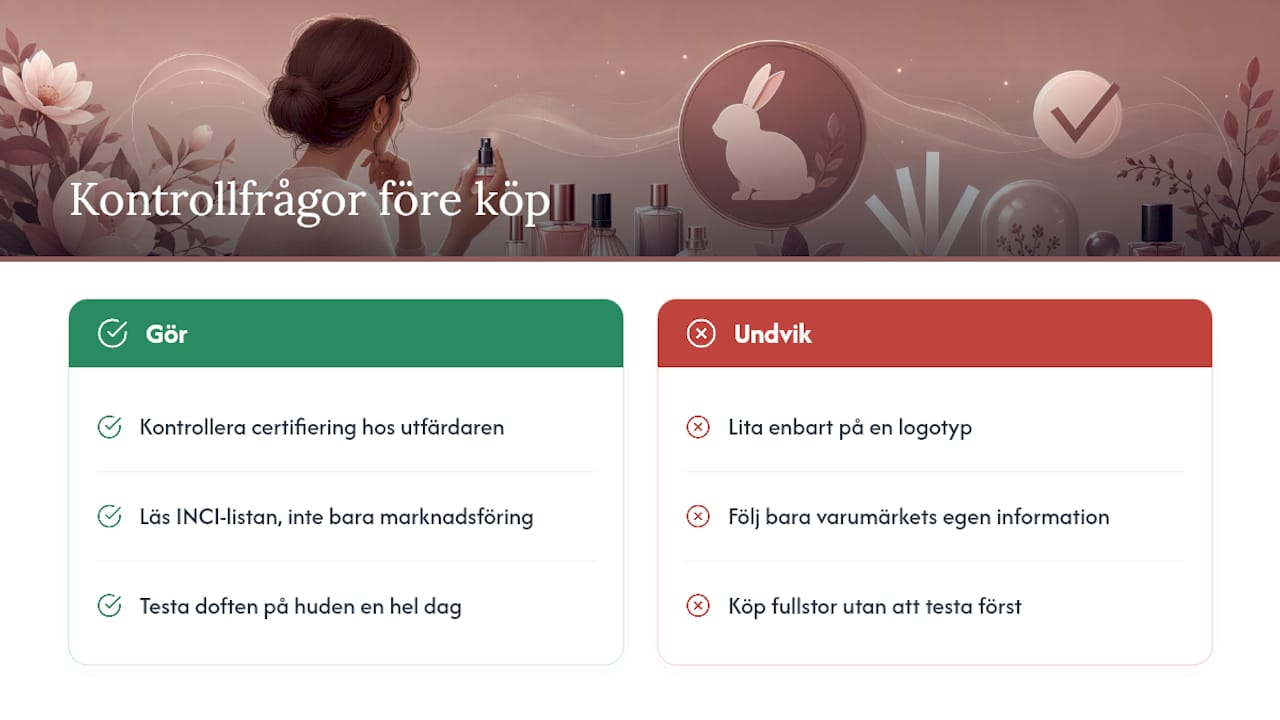
Before you click “buy,” ask yourself three questions: Is the certification verifiable with the issuing body, not just on the brand's own site? Have I actually read the INCI list, not just the front-of-pack marketing copy? And have I tested the scent on my own skin for at least a full day before deciding?
— Axel
Try INGRID's vegan solid perfumes risk-free
INGRID is the alternative to guesswork purchases and single-use bottles: you test the scents at home at your own pace, and the cost of the sample kit is deducted when you decide on a full-size product.
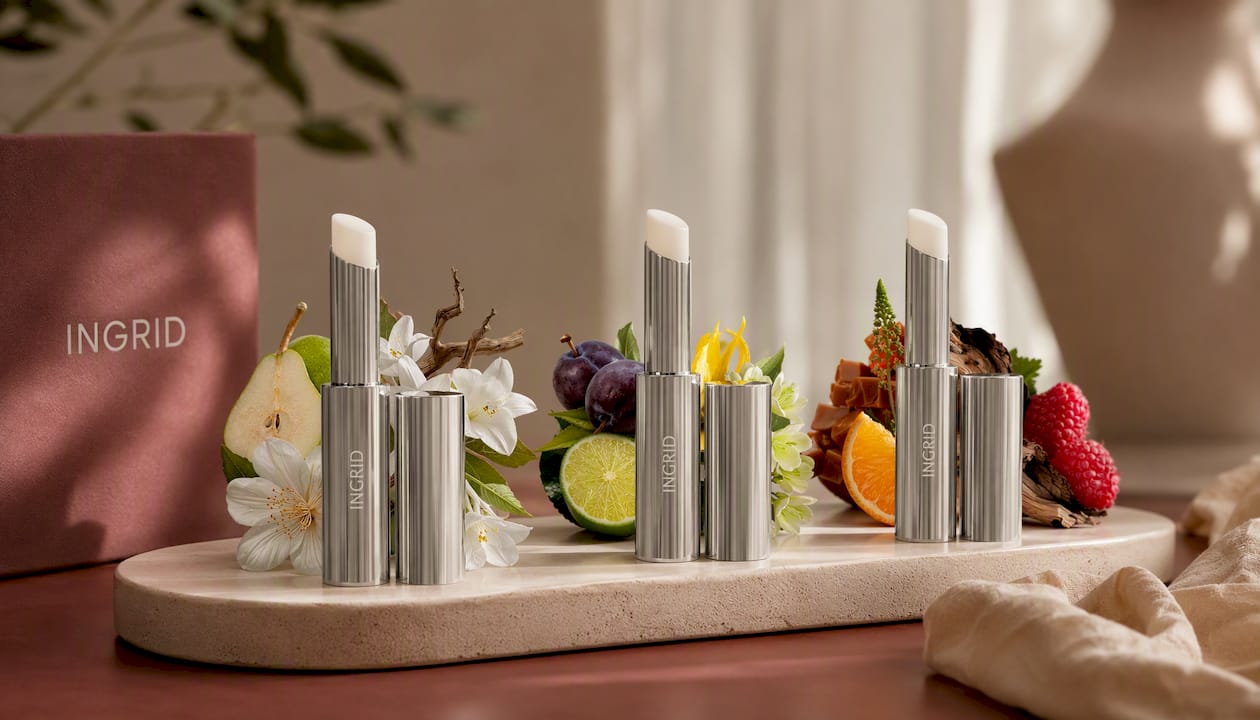
Three scents cover different needs. Scandinavian Breeze suits anyone who wants a light, clean everyday scent — one that doesn't take over, just quietly exists as a natural part of the day. Whisper is the discreet favorite, meant for closeness rather than filling a room, and works just as well at work as on a quiet evening at home. Feelin Fierce is the more intense option for when you want to be noticed — a night out or an occasion that calls for a bit more character.
All three are vegan, cruelty-free, and built on wax instead of alcohol and water, entirely free of plastic packaging, and every order results in a planted tree. Order a sample kit from INGRID to try every scent before you choose, or go straight to a favorite: Scandinavian Breeze, Whisper, or Feelin Fierce. If a scent doesn't feel right once you're home, INGRID's return policy applies, so the risk of ending up with a bottle you never use is minimal.
Sources
Certifying bodies' own databases are always the safest way to double-check a brand's cruelty-free status before buying.