
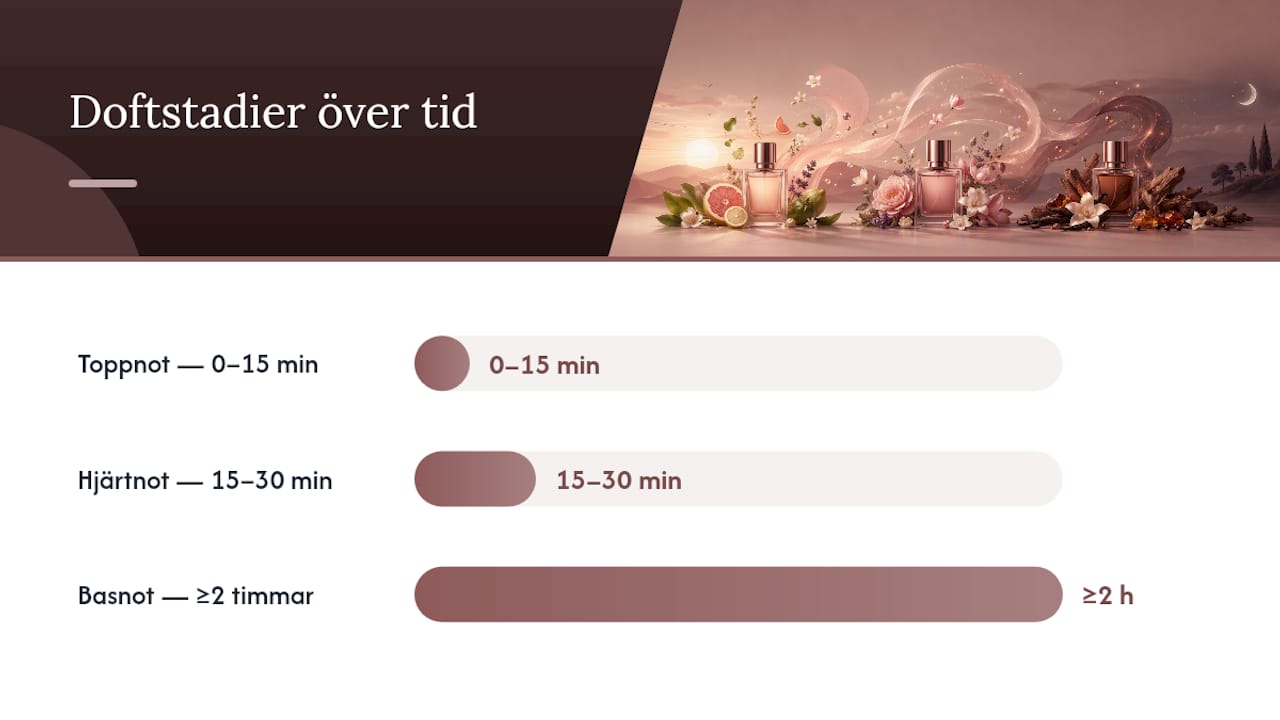
Fragrance is built from top, heart, and base notes, and the three layers evaporate at different speeds. The top note greets you first but fades within minutes, the heart note takes over after a while and reveals the fragrance's true character, while the base note lingers longest and gives the perfume its staying power. Always test on skin, not just a paper strip, and wait at least 15 minutes before judging the whole. If you want a natural scent without alcohol, solid perfumes can be a good option to try.
In short:
- Most perfumes fade quickly on skin, which makes it important to wait at least 15 minutes to judge the fragrance correctly.
- The fragrance pyramid shows that top notes disappear within minutes, while base notes can last all day, and you should test on skin rather than paper.
- Fragrance families are organized into a fragrance wheel, which helps you find similar or opposite scents to expand your scent wardrobe.
- Perfume concentrations like EdC, EdT, EdP, and Parfum have different levels of fragrance oil and last anywhere from a few hours to a full day.
- Solid perfumes, free of alcohol, give a more even scent development and work well for layering and on the go, especially if you want to avoid sprays and leaks.
Table of Contents
- The fragrance pyramid: top, heart, and base notes — what they are and how they develop
- Fragrance families and the fragrance wheel — find your category
- Perfume concentrations: EdC, EdT, EdP, and Parfum — what to choose
- How to test and apply perfume correctly: step by step
- Choosing the right scent for you: concrete criteria and a simple decision framework
- The writer's take: why vegan solid perfumes work in practice
- Editorial: what most fragrance guides miss
- A practical alternative: try INGRID's solid perfumes
- Sources
The fragrance pyramid: top, heart, and base notes — what they are and how they develop
A perfume's structure is often called the fragrance pyramid, and it describes how different molecules evaporate at different speeds. Fragrance notes are grouped into three layers (Swedish source): top notes, heart notes (also called middle notes), and base notes, where top notes disappear fastest and base notes give the fragrance its long-lasting character.
- Top notes consist of small, light molecules like citrus, bergamot, and lavender. They evaporate quickly and give the perfume its first, often fresh, impression.
- Heart notes step forward once the top has settled after a while. Here you'll find florals like rose and jasmine, spices like cinnamon, or fruit. The heart tends to describe what the fragrance is actually "about."
- Base notes like vanilla, sandalwood, musk, and patchouli have heavier molecules that evaporate slowly. They act as fixatives and hold the lighter notes on the skin longer, which is crucial for how long the fragrance lasts.
A common example is a perfume that opens with lemon and bergamot, glides into a heart of jasmine and rose, and lands in a base of sandalwood and musk. In the first few minutes it smells fresh and lively. After an hour it feels warm and floral. After four hours, only the soft, woody base remains noticeable. That very shift is the core of any real fragrance notes guide, and it's also why a perfume should never be judged right at the first spray.
Fragrance families and the fragrance wheel — find your category
Fragrance families make it much easier to navigate among thousands of perfumes. Fragrance families are often organized into a fragrance wheel (Swedish source) with categories like floral, oriental, woody, gourmand, citrus, aromatic, and green, where each family shares a common character trait.
- Floral: rose, jasmine, peony. Often romantic and feminine, but works unisex too in more modern interpretations.
- Oriental: vanilla, amber, spices. Warm, sensual, and heavy, best suited for evening or cold seasons.
- Woody: sandalwood, cedarwood, vetiver. Dry and earthy, often the base of unisex scents.
- Gourmand: caramel, chocolate, praline. Sweet, edible notes that make the fragrance almost appetizing.
- Citrus: bergamot, lemon, mandarin. Fresh and energizing, most common in top notes.
- Aromatic: lavender, rosemary, sage. Herbal and clean, popular in classic men's fragrances.
- Green: grass, leaves, galbanum. Sharp and nature-close, often used to balance heavier compositions.
A fragrance wheel works best as a map rather than a rulebook. If you like a perfume in the oriental family, you can find similar options in the neighboring gourmand family, since they share warmth and sweetness. If you want to challenge yourself, try a family on the opposite side of the wheel, for example moving from heavy oriental to sharp green, to see how differently your own sense of smell reacts.
Perfume concentrations: EdC, EdT, EdP, and Parfum — what to choose
Perfume strength is usually labeled as Eau de Cologne (EdC), Eau de Toilette (EdT), Eau de Parfum (EdP), and Parfum (Swedish source), and the difference lies in how much fragrance oil the bottle contains.
- Eau de Cologne: contains a relatively low percentage of fragrance oil and lasts a shorter time, perfect for a quick refresh on a warm day.
- Eau de Toilette: contains a moderate percentage of fragrance oil and lasts a few hours, a good everyday choice for the office.
- Eau de Parfum: higher fragrance oil percentage and longer-lasting, a common choice between strength and price.
- Parfum (Extrait): the most concentrated form, can last all day with a more intense scent and lower projection.
If you travel a lot, a smaller EdT bottle or a solid perfume is easier to bring along without liquid rules to think about. If you're testing new scents before committing to a full bottle, a smaller sample is always smarter than gambling on a full EdP right away.
How to test and apply perfume correctly: step by step
Testing perfume correctly is the difference between buying a scent you love and one you regret after four hours. An established testing method is built on never trusting the first impression straight from the bottle.
- Spray on a blotter (test strip) first to get a quick, unaffected impression of the top note.
- Apply to skin, ideally on the inside of the elbow or on the neck, since skin's warmth and oil content affect how the scent develops.
- Wait 15–30 minutes before drawing a conclusion. The heart note needs time to emerge.
- Compare no more than three scents at once. More than that and your nose loses the ability to tell them apart.
Spray on pulse points like the wrists, neck, and inside of the elbows, where blood flow is strongest and warmth helps the scent spread. Avoid rubbing perfume into the skin, since friction can break down the fragrance molecules and make it fade faster. Damp skin holds scent better than dry skin, so an unscented cream before application often extends longevity noticeably.
Pro tip: Never test a new perfume on a day with an important meeting. Give yourself at least a couple of hours at home where you can experience the full scent journey, from top to base, before deciding.
Choosing the right scent for you: concrete criteria and a simple decision framework
Before buying, ask yourself three questions: Which notes are you already drawn to in other contexts, like food or candles? Should the scent be worn daily or saved for special occasions? And how long do you want it to last, a quick refresh or all day?
Building a small scent wardrobe instead of chasing a single signature scent makes it easier to match the right feeling to the right occasion. A well-thought-out wardrobe might look like this:
- Everyday and office: a lighter citrus or green scent that doesn't take over a room, ideally in a milder concentration.
- Work with more social contact: a balanced floral or aromatic scent, discreet but noticeable up close.
- Evening and parties: a heavier oriental or gourmand scent with more projection and longer longevity.
Skin chemistry plays a bigger role than most people think. The same perfume can smell completely different on two people depending on skin pH, oil content, and even what you've eaten. That's exactly why testing on your own skin always outweighs a review you read online, no matter how many people liked the scent.
The writer's take: why vegan solid perfumes work in practice
This guide is written by Axel, who has studied how natural fragrance oils and alcohol-free formulas behave on skin compared to traditional spray perfumes.
Wax-based solid perfumes lack the alcohol that otherwise sends the top note flying off within minutes. The result is a more even scent journey, where the heart and base get to take up more space right from the start. That makes them especially practical for layering (Swedish source), since a rich, wax-based base settles as a discreet foundation that other scents can be built on top of without clashing. A small tin also fits in a jacket pocket without any leak risk, which makes everyday testing simpler than with glass bottles. If you want to see that principle in practice, INGRID's collection of solid perfumes is a good place to start.
Editorial: what most fragrance guides miss
Most fragrance guides stop at explaining top, heart, and base as theory. The genuinely useful step, actually waiting out the full scent journey before deciding, is one they often skip. I think that habit is the biggest reason so many perfumes end up unused in a drawer after three wears.

Conventional advice also focuses almost exclusively on the spray bottle, as if it were the only format that counts. But an alcohol-free, wax-based scent behaves differently on skin, more stable, less volatile, and it deserves a place of its own in the conversation rather than being treated as a niche choice.
Prioritize this: learn to recognize your own favorite family before spending money on new bottles. A scent wardrobe with three well-considered choices always beats a shelf full of impulse buys.
— Axel
A practical alternative: try INGRID's solid perfumes
If you want to put the fragrance pyramid into practice without committing to a full EdP bottle, solid perfumes are a natural next step. They're vegan, alcohol-free, and built on real fragrance oils, which gives exactly the more even development between top, heart, and base that this guide describes above.
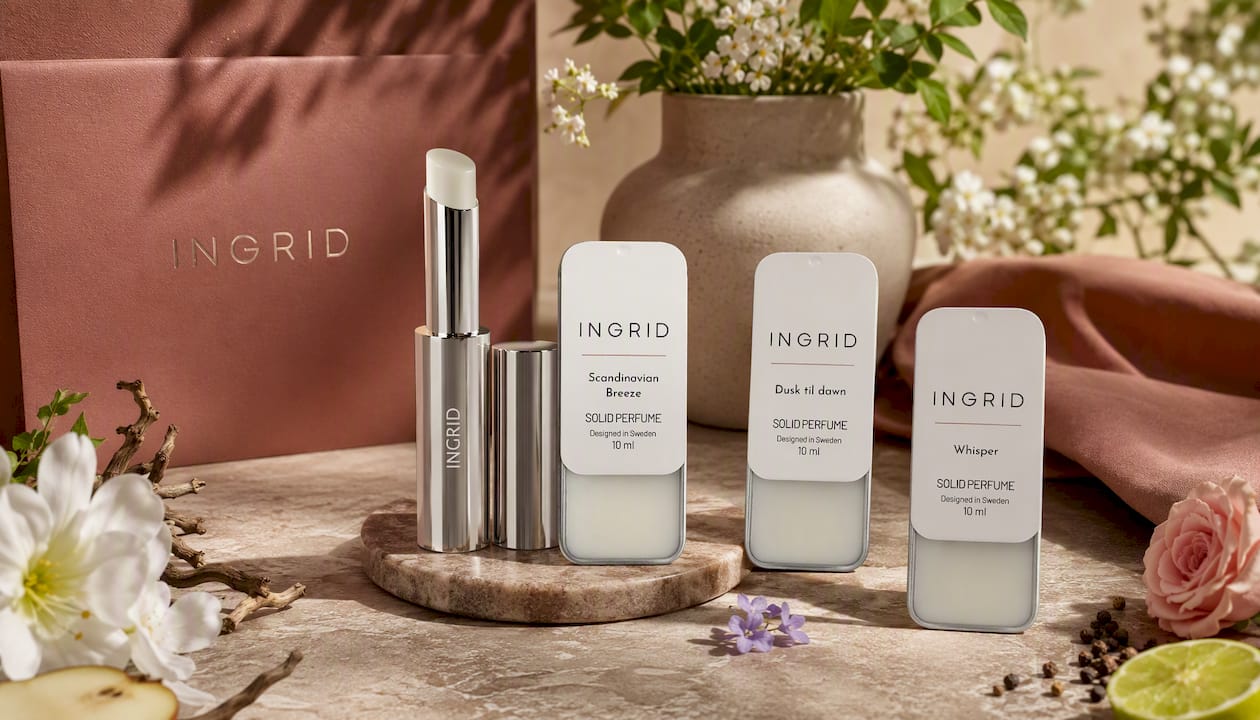
Scandinavian Breeze is the fresh option for anyone drawn to citrus and green families who wants a scent for everyday and office wear. Dusk till Dawn (for men) leans toward heavier, woody, and oriental tones and suits evening wear better. Whisper sits softly between floral and gourmand, a safe choice for work where you want to be noticed without taking over the room.
All three work excellently as part of a scent wardrobe or for layering, exactly as described in the application section above: apply to pulse points, avoid rubbing in, and let the warmth of your skin do the work. If the scent is meant as a gift rather than a purchase for yourself, order a sample set so you're not guessing. Read more about the full sustainability story behind the brand on INGRID's own page, and try Whisper or Dusk till Dawn in your next order.